

Yet most cardiovascular problems develop silently over years before any symptoms appear. A standard cholesterol test only tells part of the story. At Vitalis Health, we go deeper to uncover the risks that routine check-ups miss.
Most health check-ups will tell you your total cholesterol and LDL. We go further. Our cardiovascular risk assessment is built around validated clinical risk scoring tools that combine your lab results with your personal and family medical history to produce a meaningful risk picture.
We calculate your QRISK3 score, which estimates your probability of having a heart attack or stroke within the next ten years. We also calculate your Framingham risk score, giving you two independent, globally validated perspectives on your cardiovascular future. These are not just numbers on a page. In your Bio-Physical Profile report, each score is interpreted with a clear risk category and a written clinical assessment explaining what it means for you personally.
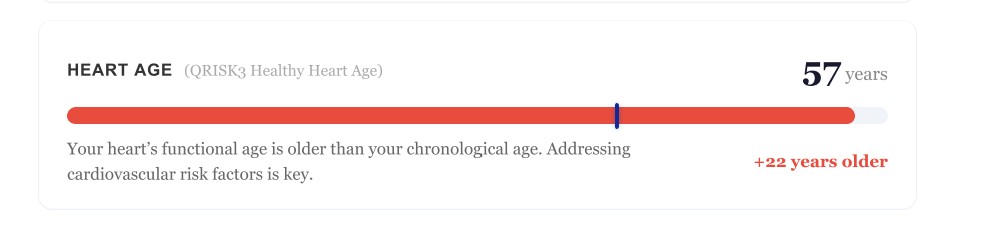
We also calculate your Heart Age, which compares the functional age of your cardiovascular system to your actual chronological age. For example, a 35-year-old patient might discover that their heart is functioning like that of a 57-year-old. This single insight is often more motivating than any lab value, because it makes the risk tangible and personal.
Beyond risk scores, we measure biomarkers that give us a deeper view of what is happening inside your arteries. Apolipoprotein B (ApoB) is now considered the most accurate blood marker for predicting atherosclerotic cardiovascular disease, and it often reveals risk that standard LDL testing misses. Lp(a) is a genetically inherited risk factor that affects roughly one in five people and cannot be modified through diet or exercise, making early detection essential for understanding your true baseline risk. hsCRP measures vascular inflammation, helping us understand whether chronic low-grade inflammation is silently accelerating damage to your arteries.
We also evaluate your complete lipid profile including total cholesterol, LDL, HDL, triglycerides, and non-HDL cholesterol. Depending on your individual profile, we may include ABPI (ankle-brachial pressure index) to screen for peripheral arterial disease, an ECG to evaluate heart rhythm, and a treadmill stress test to assess how your heart performs under exertion.
Your cardiovascular findings are presented as part of your comprehensive Bio-Physical Profile report. You receive your QRISK3 and Framingham risk scores with a clear risk category (low, moderate, or high), your Heart Age compared visually against your chronological age, and a detailed clinical impression that ties all the findings together.
If your cardiovascular risk is elevated, your report includes personalised lipid targets based on the latest clinical guidelines, recommended medications or adjustments, specific dietary and exercise advice tailored to your risk level, and a follow-up testing schedule so you can track your progress over time.

This assessment is valuable for anyone who wants to understand their true cardiovascular risk, but it is especially important if you have a family history of heart disease or stroke, if you are over 40 with risk factors such as high blood pressure, smoking history, diabetes, or excess weight, or if you have been told your cholesterol is borderline but received no further evaluation. It is also recommended if you have already been diagnosed with a cardiovascular condition and want a detailed risk profile to guide your ongoing management.
Cardiovascular risk is one of eight domains assessed in our Smart Whole Body Check-up. Rather than looking at heart health in isolation, the check-up evaluates how your cardiovascular risk interacts with your metabolic health, kidney function, liver health, body composition, nutritional status, mental wellness, and biological age. Together, these eight domains give you a complete, personalised health profile with a clear action plan.
This assessment is part of our Smart Whole Body Check-up, which evaluates eight risk domains to give you a complete, personalised health profile.